Skip to content
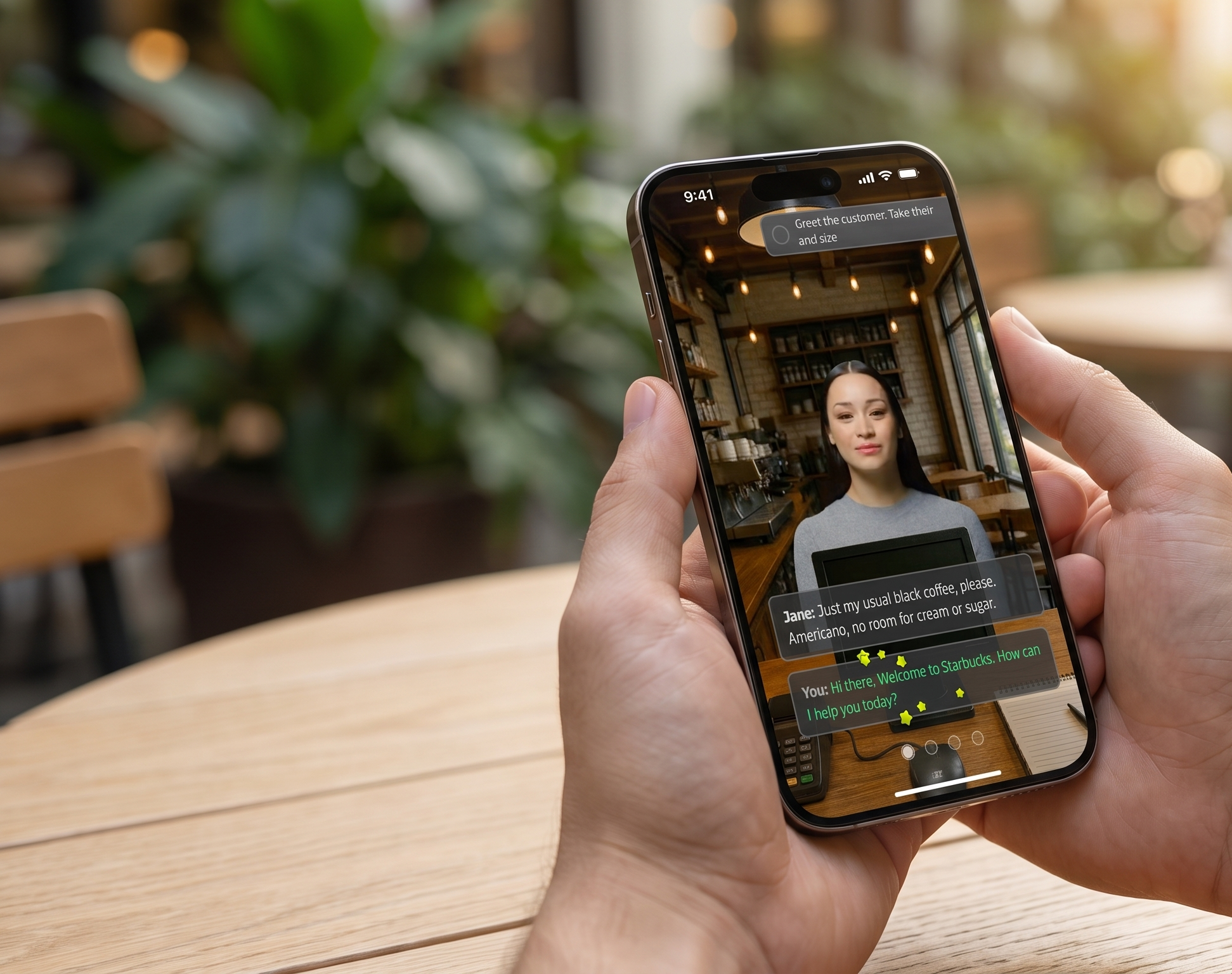
Hands holding a smartphone display a virtual AI assistant taking a coffee order at an outdoor cafe.

Insights

Simulation training: what it is, how it works, and when to use it

Simulation training lets employees practice the real situations of their job before they face them. Here's what it is, the main types, why it works, and when it's worth the investment.

Karen Klakegg · VP of Marketing

Published

By Karen Klakegg, VP of Marketing at Attensi · Last updated: 23 September 2026

Nobody lets a pilot's first engine failure happen at 30,000 feet. Aviation has trained people in simulators for decades because some mistakes are too costly to learn from on the job. For a long time, that logic stayed with pilots, surgeons, and plant operators, where the stakes justified the price. That's no longer true.

Simulation training now runs on the phones and laptops employees already use, and AI has cut the time it takes to build. This guide explains what simulation training is, the main types, why it works, and when it's worth using.

Key takeaways

  • Simulation training puts employees in realistic, interactive scenarios where they practice the tasks and decisions of their role before doing them for real.
  • It works because it combines realistic practice, a safe place to fail, immediate feedback, and repetition.
  • Research in medical education found simulation with deliberate practice produced better skill outcomes than traditional clinical training.
  • It's most valuable where mistakes are costly, conversations are hard, or skills need to be consistent at scale.

What is simulation training?

Simulation training is a learning method that uses true-to-life, interactive environments to let employees practice the tasks, decisions, and conversations of their role. Learners act instead of watching: they make choices, see the consequences, and try again.

Most simulation training today is delivered through software on phones, laptops, or VR headsets. It's also called simulation-based training or simulation-based learning.

The main types of simulation training

Simulation training isn't one format. The right type depends on the skill you're building.

TypeBest forCommon uses
3D scenario simulationsBest forDecisions, procedures, customer interactionsCommon usesRetail, hospitality, financial services
AI role-playBest forLive dialogue under pressureCommon usesSales, customer service, leadership
Software and process simulationsBest forLearning new systems and workflows safelyCommon usesIT rollouts, healthcare systems, call centers
VR and AR simulationsBest forPhysical, spatial, or hazardous tasksCommon usesEnergy, manufacturing, safety training
High-fidelity physical simulatorsBest forOperating complex equipmentCommon usesAviation, medicine, the military

Why simulation training works

Simulation training works because it closes the gap between knowing what to do and being able to do it. Four mechanisms do most of the work.

Realistic practice. Skills transfer best when practice resembles the real situation. A simulated difficult customer is much closer to the real thing than a slide about difficult customers.

A safe place to fail. Mistakes in a simulation cost nothing, so people try things, get them wrong, and learn why. In a classroom role-play, the fear of looking foolish in front of peers often stops that from happening.

Immediate feedback. Learners see the result of each decision straight away, while the choice is still fresh.

Repetition. People can run the same scenario until the right response becomes automatic. When the experience has scores and levels, many choose to.

The evidence is strongest in medicine, where simulation has been studied for decades. A 2011 meta-analysis by William McGaghie and colleagues compared simulation-based medical education with traditional clinical education. Simulation combined with deliberate practice produced better results for specific clinical skills.

The benefits of simulation training

Gain technical skills without the risk

Every role has technical skills that are costly to learn through real mistakes. Simulation gives people a space to apply those skills through trial and error, whether that's assessing an insurance risk or following a safety procedure.

Develop problem-solving skills

Simulations aren't only for hard skills. Branching scenarios put people in front of unexpected situations and ask them to decide, which builds the critical thinking and judgment real work demands.

Build communication skills that transfer

Listening, questioning, and handling pushback are hard to learn from a course. Simulated conversations let people rehearse them repeatedly, with feedback, before they matter.

Deliver consistent training at scale

A simulation delivers the same quality of practice to the 10th learner and the 10,000th. Every employee meets the same standard, in any location, at a time that suits them.

Simulation training vs traditional training

FactorTraditional trainingSimulation training
How people learnTraditional trainingListening, reading, watchingSimulation trainingDoing, deciding, and seeing the consequences
Cost of mistakesTraditional trainingReal mistakes happen on the jobSimulation trainingMistakes happen in training, at no cost
PracticeTraditional trainingLimited to class time or a colleague's patienceSimulation trainingUnlimited and on demand
ConsistencyTraditional trainingVaries by trainer and locationSimulation trainingSame experience for every learner
ScaleTraditional trainingNeeds rooms, trainers, and travelSimulation trainingRuns on devices people already have
MeasurementTraditional trainingAttendance and quiz scoresSimulation trainingDecisions, scores, and progress on every attempt

When simulation training is the right choice

Simulation isn't the answer to every training need. A policy update or a product fact sheet doesn't need a 3D scenario. Simulation earns its place when at least one of these is true:

  • Mistakes on the job are expensive, dangerous, or damaging to customer relationships.
  • The skill happens in live conversation or under time pressure.
  • You need the same standard across many people, sites, or countries.
  • People need to practice a skill many times before it becomes reliable.

The traditional objection has been cost, because bespoke simulations used to take months to build. That's the part AI has changed most.

How AI is changing simulation training

Faster builds. AI tools can turn a brief or existing training material into a working simulation in a fraction of the time custom development used to take. That makes simulation realistic for smaller budgets and fast-changing content.

Unscripted conversations. Traditional simulations follow branching scripts. AI role-play respond to whatever the learner actually says, so every practice run is different, much like a real customer or colleague.

Richer feedback. AI can assess not just which option someone chose but how they phrased it, and give specific feedback after each attempt.

Example: how Hiscox trains underwriters with simulation

Insurer Hiscox worked with Attensi to build what the two companies describe as the world's first training simulator for underwriters. Underwriters practice case analysis and conversations with brokers and claims teams in realistic scenarios.

Hiscox cut underwriter training from 60 hours of classroom time to three hours, a 95% reduction. 80% of participants said they felt more confident in their ability as an underwriter, and learners repeated each module four times on average.

“It’s a very safe space to make errors. You’re not going to get everything right the first time and that’s okay. It’s good to have another go.”

Charles FriendRegional Underwriting Manager, Hiscox

Where Attensi fits

I work for a training company, so weigh this section accordingly. Attensi builds simulation training that combines realistic 3D scenarios, AI conversation practice, and game mechanics, grounded in behavioral psychology.

Employees practice real work situations in immersive 3D simulations and live conversations through AI role-play. L&D teams can build their own training with AI-powered content creation tools, and insights and analytics show how skills are developing across teams.

For more on where the idea came from, read what L&D can learn from pilot simulation training.

For the bigger picture on building and measuring training that changes performance, read our guide to corporate training programs.

For how simulation applies to people skills like communication, empathy and coaching, read our guide to soft skills training.

Sources

  1. McGaghie, W.C., Issenberg, S.B., Cohen, E.R., Barsuk, J.H. and Wayne, D.B. (2011) 'Does simulation-based medical education with deliberate practice yield better results than traditional clinical education? A meta-analytic comparative review of the evidence', Academic Medicine, 86(6).
  2. Attensi, 'Hiscox: speed, scale and a safe place to fail'.

About the author

Karen Klakegg is VP of Marketing at Attensi, where she has spent nearly seven years working on how organizations train their people and measure the results.

Karen Klakegg smiling in a black and white portrait in a bright interior
Karen KlakeggVP of Marketing | Attensi

SIMULATION TRAINING FAQ

Frequently asked questions

Want to see simulation training in practice? Book a demo.

You might also be interested in